


MCP2515 CAN Bus Module Board with TJA1050
MCP2515 CAN Bus Module Board with TJA1050
Couldn't load pickup availability
Overview
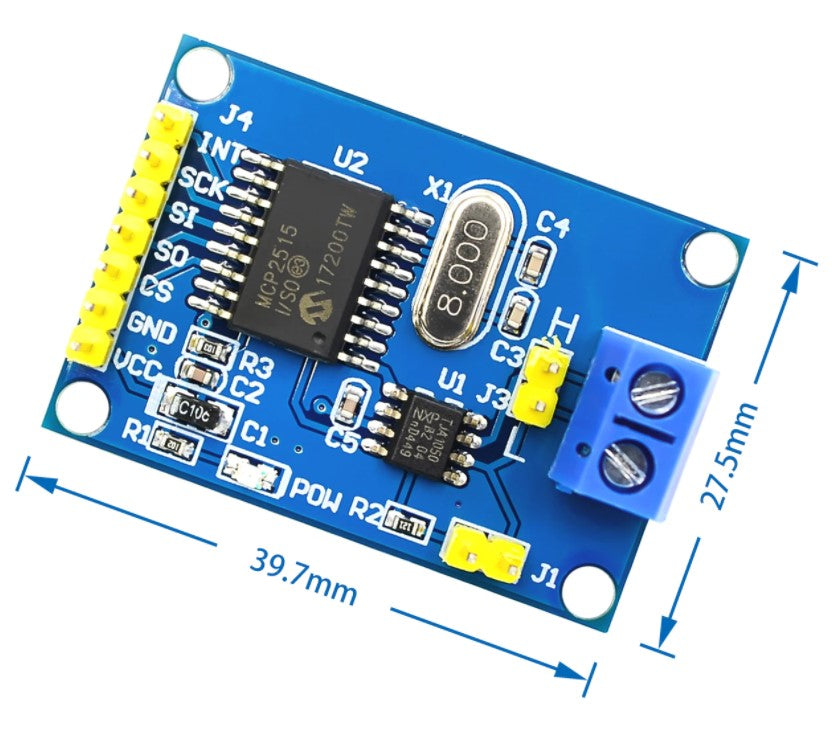
An SPI CAN bus module that pairs the MCP2515 CAN controller with a TJA1050 CAN transceiver, so a microcontroller can join a CAN bus with four SPI wires. The MCP2515 handles CAN V2.0B frames in hardware and the TJA1050 drives the CANH and CANL bus lines, so your Arduino sketch only has to talk SPI.
Key features
- Two chips, one complete CAN node — the MCP2515 (CAN V2.0B, 0 to 8 data bytes) plus the TJA1050 transceiver (ISO 11898) means the microcontroller needs only an SPI port
- Buffers and filters on the chip — the MCP2515 has three transmit buffers, two receive buffers, six acceptance filters and two masks, so it can ignore traffic you do not need
Applications
- Linking an Arduino to other CAN bus nodes over a twisted pair
- A two-node CAN test bench on your desk
- Learning how CAN frames, IDs and filters work
Compatibility
- Arduino UNO / Nano (5 V): ✓ Yes Direct SPI wiring, no level shifter needed.
- ESP32 / ESP8266 (3.3 V): With adapter The module is powered at 5 V and its SO pin outputs 5 V logic, so use a level shifter on the SPI lines.
- Raspberry Pi Pico (3.3 V): With adapter Needs a level shifter. We have not verified a MicroPython driver for the MCP2515, so no Pico code is given.
- Software: ✓ Yes Arduino IDE with the arduino-mcp2515 library (autowp).
Specifications
| Compatibility | Arduino UNO / Nano (5 V): ✓ Yes Direct SPI wiring, no level shifter needed., ESP32 / ESP8266 (3.3 V): With adapter The module is powered at 5 V and its SO pin outputs 5 V logic, so use a level shifter on the SPI lines., Raspberry Pi Pico (3.3 V): With adapter Needs a level shifter. We have not verified a MicroPython driver for the MCP2515, so no Pico code is given., Software: ✓ Yes Arduino IDE with the arduino-mcp2515 library (autowp). |
|---|---|
| Dimensions | Approx. 44 × 28 mm |
| Included Items | 1 × MCP2515 CAN bus module (TJA1050) |
| Product Code | MOD-CAN-BUS-MCP2515-BOARD-TJA1050-NZ |
| Applications | Linking an Arduino to other CAN bus nodes over a twisted pair, A two-node CAN test bench on your desk, Learning how CAN frames, IDs and filters work |
| CAN controller | MCP2515 (Microchip) |
| CAN protocol | CAN V2.0B |
| CAN transceiver | TJA1050 (NXP) |
| Crystal | 8 MHz |
| Data field | 0 to 8 bytes |
| Frame types | Standard, extended and remote |
| Host interface | SPI (MCP2515 supports SPI modes 0,0 and 1,1, up to 10 MHz) |
| Maximum bit rate | 1 Mb/s |
| Mounting holes | 4 × 3 mm |
| Operating temperature | −40 °C to +85 °C (MCP2515 industrial grade) |
| SPI header (J4) | 7 pins, in this order: INT, SCK, SI, SO, CS, GND, VCC |
| Supply voltage | 5 V DC (TJA1050 supply range 4.75 V to 5.25 V) |
Package contents
- 1 × MCP2515 CAN bus module (TJA1050)
Frequently asked questions
What is included?
The package includes 1 × MCP2515 CAN bus module (TJA1050).
What is it compatible with?
Verified compatibility: Arduino UNO / Nano (5 V): ✓ Yes Direct SPI wiring, no level shifter needed., ESP32 / ESP8266 (3.3 V): With adapter The module is powered at 5 V and its SO pin outputs 5 V logic, so use a level shifter on the SPI lines., Raspberry Pi Pico (3.3 V): With adapter Needs a level shifter. We have not verified a MicroPython driver for the MCP2515, so no Pico code is given., Software: ✓ Yes Arduino IDE with the arduino-mcp2515 library (autowp).
Warranty
1 Year Techexpress NZ Guarantee: This product includes a 1 Year Techexpress NZ Guarantee.
Order online from Techexpress NZ.


Product questions & answers
Understand how this product works and whether it suits your setup. Have a question? Our team reviews and emails answers 24/7—typically within 1–2 hours.